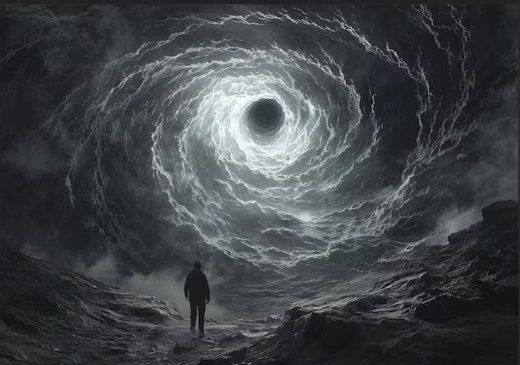
The embrace of nothingness is the way.
There is nothing
The embrace of nothingness is the way.
· There is nothing we must do or be
· There is nothing we “know”
· There is nothing we can say about God that is not a story of our own making
· There is nothing we can say about ourselves/others that is not a story of our own making
The first story in Genesis is a great illustration. The story is about how humans, when we just live with what is, and pursue nothing – we are in paradise. But when we buy in to the lie/ accusation that all is not well and something more is needed (“your eyes will be opened, and you will be like God, knowing good and evil.”), we cast ourselves out of paradise.
The fruit (or the lie) is that the way to be better is to engage in dualistic thinking and judgement -- to know what is good and what is bad and embark in a project of rejecting the bad and pursuing the good. It’s tempting. It looks good, it sounds good. It seems nourishing and wholesome.
Outside of this lie/accusation we are existing in grace. Not a grace that says we did something wrong and we are pardoned, but a grace that says, nothing is wrong, all is well just as it is. Nothing is needed.
You might read the story as if God punished them and then cast them out of paradise, but another way to read it is that they cast themselves out. After all, nothing was different before they ate and after they ate - - they were still naked.
What had changed was their mindset, their viewpoint.
Maybe when we read the list of things that would happen to them - which I was always taught was a list of punishments for their sin, what we are reading was simply a description of what life is like when it is lived from ego mind (the dualistic , judgemental mindset).
· Enmity
· Pain
· Power and control between people (especially men and women)
· Out of harmony with nature
It seems unlikely that the god character in the story would in one paragraph be punitive and increasing their suffering, while in the next paragraph make them garments to cover their shame, and alleviate their suffering,.
Even the cherubim with the flaming sword that keeps them from the tree of life could be seen as the God character being merciful. Recognizing that a life lived from ego will be filled with suffering and to live eternally would be unbearable, death, in this way is God’s mercy. Just like the animal skin coverings.
God did not tell them they were naked, he asks – “who told you that you were naked?” In other words, “I never said anything about nakedness, who accuses you?” (it was their own minds).
Jesus said to the woman caught in adultery, “who condemns you? Where are your accusers?” and when she said her accusers were gone, he said, “Neither do I condemn you.” (the accuser wasn’t Jesus, it was other people)
In the Eden story grace is not forgiveness or unmerited favor as we sometimes think of grace. Grace is not God foregoing deserved punishment or covering over our sins – grace is the state of being that they were in before they ate the fruit (bought into the lie). Grace says there’s nothing wrong (we are in paradise), until and unless our minds start to judge and label what is good and what is evil. Grace is resting in the paradise of mind that knows that nothing more is needed. Grace is the state in which we recognize that we are not separate from God or anything else unless we believe the accusation that we are.
When we believe that we are not as we should be and we must improve to become more like God, we move from existing in a mindset of grace to a mindset of judgement of good and evil. What is good and evil about ourselves (we are naked and ashamed!) and what is good and evil in others (and the world).
This was the first and only lie. The continual lie, the continual accusation. You need to know what is good and what is not so you can be better, more like God. You find meaning in life by making things better.
One could say the Eden story is a story about Ego. The ego-mind is dualistic, it labels things as good and bad, it judges self and others, it likes to exercise power over, it likes to label, categorize and name. It likes to become something, it likes to “be like God.”
Religion can be very ego-based. Religiously, the ego believes the path to life is to enact power by engaging in sacrificial “death-acts” defined as turning away from wrong acts and thus obtaining forgiveness (grace). Or by wielding power to put to death what is perceived as wrong in the world. In this framework, the death act is an act of power to move out of the wrong-state (repentance), and a receiving of God’s power to forgive sins (grace).
The opposite of Ego is what the Bible calls “kenosis” or self-emptying. Philippians 2 is known as the “kenotic hymn”
5 Let the same mind be in you that was[a] in Christ Jesus,
6 who, though he existed in the form of God,
did not regard equality with God
as something to be grasped,
7 but emptied himself,
taking the form of a slave,
assuming human likeness.
And being found in appearance as a human,
8 he humbled himself
and became obedient to the point of death—
even death on a cross.
In kenosis, we become nothing. We turn the other cheek. We resolve to know nothing, we relinquish the power to judge (know good and evil), or to “be like God”. Repentance changes from some idea of turning away from”wrong” and toward “right” to turning away from power that take us from a “wrong” state to a “right” one. This kind of grace is a radical embrace of reality and the inherent lack that exists in ourselves and in all of reality. This kind of grace has no enemy that it fights against. This kind of grace holds everything, including what is missing as paradise. This kind of grace is non-religious, meaning, it is not transactional. It is disconnected from outcomes and agendas and thus becomes fully and completely grace. In kenosis, grace is infinite, eternal and unconditional. It includes all of it - good and bad. In its infinitude, it reflects the infinitude of God. Paradoxically, in kenosis, death becomes an engine for life.
Kenosis is at the heart of all creation. If god is infinite and fills up all space and all time, then god must have pulled back to make space for anything else to exist. In biology, all things must be biologically kenotic to continue living. If cells don’t die, it’s cancer. “Unless a seed falls to the earth and dies, it remains a single seed.” (john 12) (kenosis). Death, by definition is absolute and irrevocable.
For grace to redeem, death must be absolute so that grace can be absolute as well. Absolute death must extend even to our ideas about good and evil, and our ideas about God. Absolute grace must in some way make space for all things, even evil, just as, in some way, the kenotic nature of God has made space for both good and bad, light and darkness, fullness and emptiness.
Returning to the Eden story as our example, had humans remained in a kenotic, grace-state, they would have embraced their lack of knowledge, and lack of feeling powerful and “god-like.” The temptation for them was to turn away from a lack of power and turn toward power - from a kenotic state to a non-kenotic state. In this framework, grace is a kenotic act and to fall from grace is to fall out of kenosis and to embrace power.
The ego mind likes to feel powerful. It likes to analyze, solve the problems and have the answers. It likes to think it knows the what and why of everything. It narrates our story about ourselves, about others, about the world. The kenotic mind makes no pre-suppositions about things. We don’t really know the story, not even about ourselves. It accepts mystery, unknowing, uncertainty and what is hidden.
The ego mind even does this with our concepts of God. It makes up stories about who or what god is. What god is like. But God refuses to be named or described. God, when asked to be named said, “I am that I am.” Every description of God we can possibly come up with, is always going to be less that what God is. Is always going to be our own invention, not really God.
Maybe the closest we can come is that god is pure consciousness, awareness, is-ness, being. But ultimately, God cannot be named, pinned down, categorized or described. God can at best be experienced in the “I am-ness” of being. In presence.
In Luke 10 Mary and Martha are the contrast of ego and spirit. Martha was “worried and troubled about many things” Mary was present. Jesus said this was the only thing that is needed. Presence.
Maybe the path is nothingness. Meister Eckhart said we find God in a space of silence and nothingness. He asserts that God speaks into a space called “the potential of receptivity” This is created in silence and stillness and God must speak into that space . We must let go of images, understanding, intellect memory, sense perceptions, imagination, and even ideas about God being good or compassionate. To let go to and create a void. Thomas Aquinas, after writing some of the most prolific theological works, had a mystical experience that left his great work unfinished. He said, ‘The end of my labors has come. All that I have written appears to be as so much straw after the things that have been revealed to me. I can write no more. I have seen things that make my writings like straw.”
Krishnamurti – “This is the secret. I don’t mind what happens”
Zhuangzi - “Happiness is the absence of the striving for happiness.”
Nisargadatta Maharaj - “Accept life as it comes.”
Eckhart Tolle - “Whatever the present moment contains, accept it as if you had chosen it.”
Meister Eckhart – “There must be a silence and a stillness, and the Father must speak in that.”
Byron Katie – “when I argue with reality I lose – but only 100% of the time”